
Front-End Agro: the F87 BMW M2
Highs:
- Torque all over the rev range.
- N55 sounds great
- Insane lateral grip
Lows:
- Brakes wear fast and are expensive.
- Manual transmission gearing is too short.
- Numb steering (fixed with M4 GTS software)
Driving Style:
It’s all about the front end. Chuck it in at speed, and don’t be scared to get loose on the way out. It can be precise, but it prefers to be playful. We like driving in traction mode (Sport + tap DSC) or full Sport Plus with traction control off.
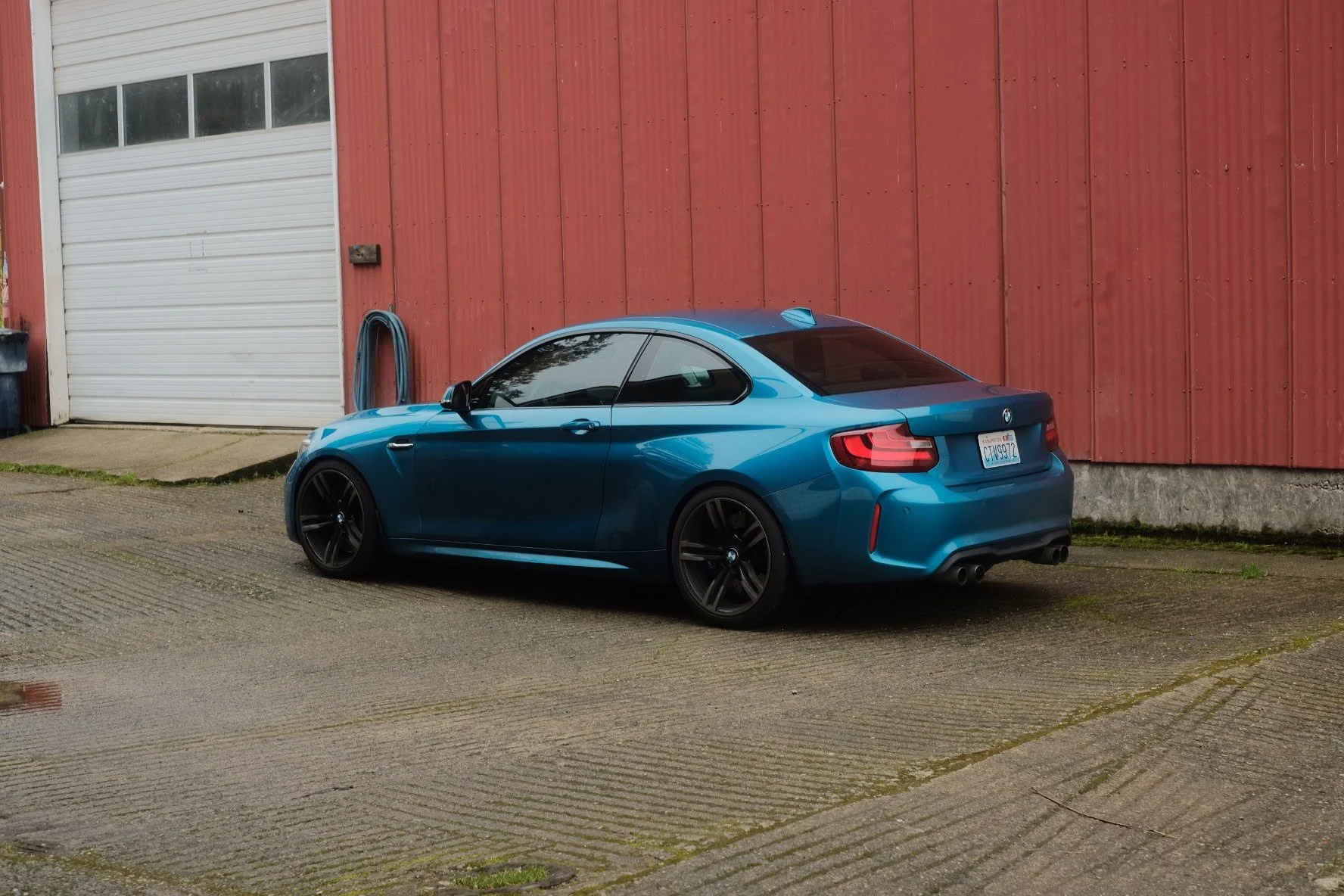
BMW has made a lot of fantastic cars. From the base 325i to hero cars like the legendary M1, pretty much every BMW is objectively a good car. Part of this magic is in the chassis: their engineers know how to design a backbone out of the box that’s both perfectly happy with a cabin full of people, and chasing GT4s on the track. The other part is BMW’s range. Other companies build cars that all follow a specific rhythm and tune, BMW has managed—over the years—to expand its audience and personality. Their base cars can feel humble yet sophisticated; their SUVs, compliant and comfortable for the whole family; and their sport “M” division, a family of aggressive, menacing sedans, coupes, and roadsters. Their M car that delivers the most confident, capable version of that attitude is the previous-generation (F87) M2.
The M2 exists because the modern M3 had gotten too big. The original E30, E36, and E46 M3s were short, rowdy chuckers; by the time the E90 M3 came around, the 3 Series started to feel more like early iterations of the larger 5 Series. So BMW built and launched the F87 M2 to fill the hole in the small BMW enthusiasts’ hearts. Technically, the 1M preceded the M2; however, with low production numbers, I’d argue that we E30/E36/E46 fans weren’t truly satisfied until the M2 came about.
The beating heart of a BMW M car is usually a race motor, but like the 1M that came before it, the M2 instead uses a “non-M” motor. Power comes from a massaged version of BMW’s twin-scroll N55: 365 hp, to be exact. While the N55 can’t trace its lineage to BMW’s race cars, the M2’s N55 is still special, with forged internals and a baffled sump to handle track work and higher boost. Simply put, it’s an incredible package. The M2 hits like a fucking hammer at any RPM and can spin tires at the top of third gear. Sure, 365 hp doesn’t sound like much by today’s standards, but you don’t need anything more. And because the N55 isn’t a temperamental race motor, it can still pull 30 MPG on the highway.
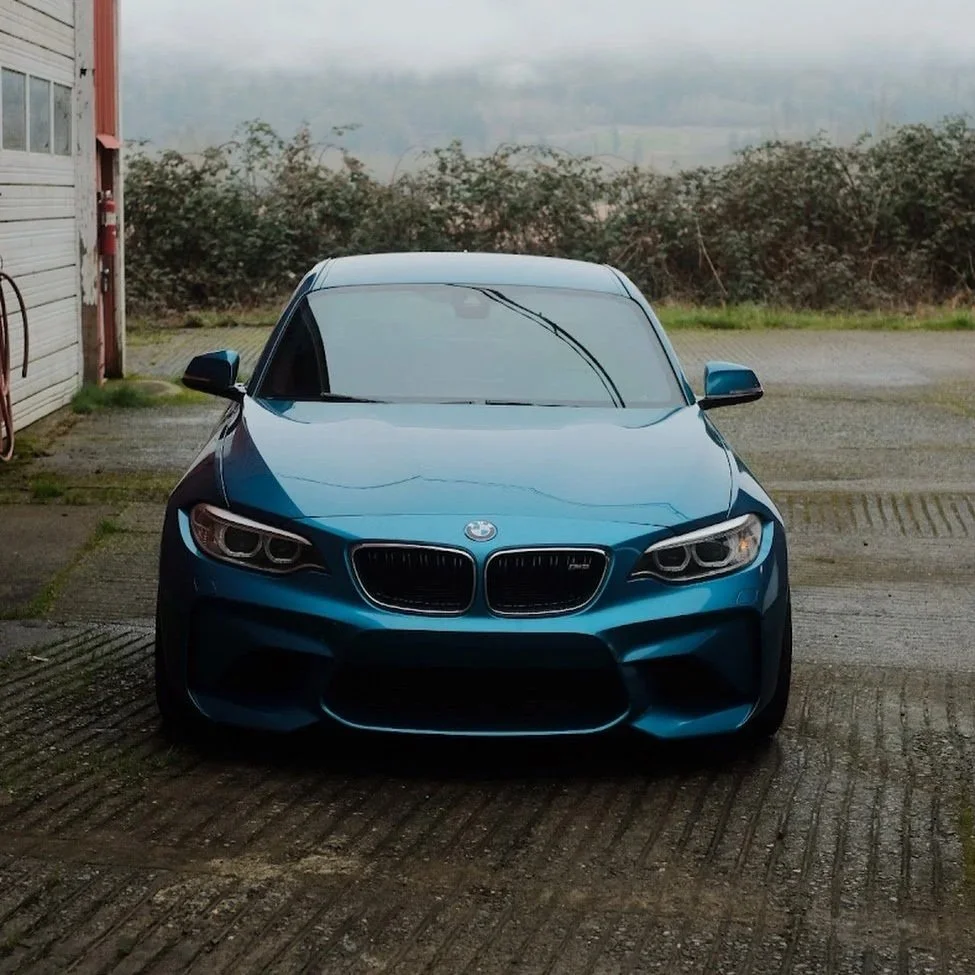
So the M2 is fast—but so are most cars on the road today. Where the BMW magic really shows up is how the car places itself on a backroad. There are a million ways to go around a corner, with driving styles ranging from precise to playful to just plain stupid. Where a Porsche approaches corners with dutiful precision, the M2 behaves like an older brother who bullies you out of love. That playful, agro driving style comes from the M2’s front-end dominance. All the weight is over the front axle; it’s the anti-911. To drive it well, brake obscenely late into a corner and turn the wheel hard. It doesn’t like to breathe—it wants to be bullied with either brakes or throttle. The car only speaks when the suspension is loaded and when it is, the lateral grip defies the laws of physics. On corner exit, the back end may wiggle, but that’s the M2’s happy spot: fast in, wild out. If you want a nice guy, buy a Porsche. The M2 wants to bare-knuckle box.
As great as the M2 is, it isn’t without compromise. First, while the interior is a simple, elegant callback to the E36 and E34, all F-series cars are prone to creaks and rattles. My other big complaint is the brakes: they’re expensive, and they wear quickly if you don’t turn stability control off. Also, in 6-speed manual form, the gearing is simply too short—you can tell the engineers were chasing 0–60 times and were quick to sacrifice distance running. Second gear runs out too soon, and sixth gear on the highway spins the motor at around 3,000 rpm. Like the interior, this isn’t a huge deal, but for a car with gobs of torque across the rev range, longer gears would’ve been appreciated. The worst part about the M2, however, is the steering feel. Out of the box, it’s worse than a video game: most feedback comes through the seat. You can feel bumps in the road through the wheel, but the corner loading is all wrong. Luckily, the M2 CS/M4 GTS software fixes this. If you buy one, this is the first $200 you should spend.
The F87 M2 has a lot going for it. It looks amazing, it has a torquey motor and a unique driving style, and its negatives are easy to look past. The M2 is a perfect one-car solution for most people: it’s all the performance car you need, while still being practical. I sold mine, but not because the car isn’t amazing. I sold it because I wasn’t looking for that front-end, do-it-all brilliance at the time. It’s an absolutely epic car; if you get one, just make sure you’re willing to punch and get punched back.

Writing by Chris Seely
